Metal sculpture
(See also: 'mathematical sculpture' with paper tape )
My interest began by accident. When our children were young, we took them to 'The Summer University'. It was an activity based holiday run at Loughborough University. The courses you could do were very varied (from yoga to making violins, from local history to painting, from water sports to model engineering, ...). The children also did their own thing, which they loved. I wasn't sure what to do the first time. Nothing took my eye, but the course on metal sculpture mentioned welding, which I thought might be useful to learn, so I signed up. It was an excellent course, and although it included some welding to produce art out of scrap metal, a lot of the time was spent casting bronze sculptures. We used the 'lost wax' process. Make a wax model and encase it in plaster, then heat the plaster so the wax melts and runs out leaving a void the shape of the wax model. Pour in molten bronze. Let it cool, remove the remains of the plaster, clean up your sculpture (repairing any bits that didn't cast properly) and polish as required. It sound easy, but it was quite hard work.
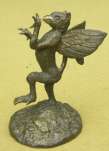
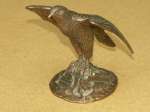
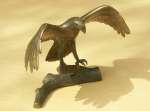
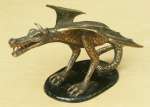
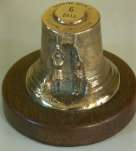
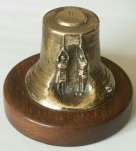
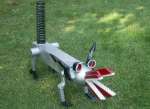
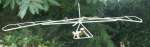
The results are all round the house, and some of them are shown in the pictures here.
The griffon is a 3-D version of the emblem of my old school (Brunts School, in Mansfield). The eagles and dragon are subjects I like. I presented the two trophies for the striking competitions of my local bellringers society (Sonning Deanery ). I forget what inspired the twisted shape, but the inward looking classical faces were from stock moulds.
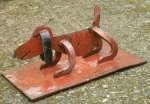
The dog is made out of bits of old machinery welded together. The spring tail wags if you push it, and also acts as a useful holder for a walking stick in the hall.
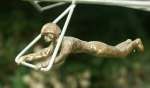
The hang glider pilot is cast bronze, and the glider is made out of welding rod. I was trying to learn hang gliding at the time, but I gave up a few months after I made this. The 'snoopy' has a practical use as a boot scraper (which had been heavily used by the time I took the picture). The horned animal head was also made from 'found' material, and hangs on the wall of my workshop.
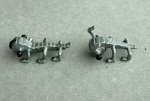
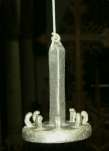
As well as casting bronze I cast several things in aluminium using the 'lost polystyrene' process. It's much quicker than lost wax casting. You make a model by carving and sanding the shape from a block of expanded polystyrene. Pack it in foundry sand and then pour in the molten metal. The heat turns the polystyrene into smoke, which disappears into the sand leaving leaving the metal in a cavity the same shape as the model. As cast, the surface preserves the pattern of the polystyrene grains. You can leave that surface to provide a natural look, as I did with the rope spider (which is used to pull up the end of the bell ropes when not in use at All Saints Wokingham) and the vase, or you can smooth and polish it, as I did with the top of the vase and all the animals.
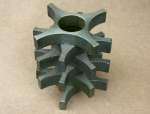
Some of the polystyrene available to us had been used for other purposes so they already had some shape. There were large blocks that had holes support and separate large bottles in transit. The holes for the bottles were about 6" diameter) and there were smaller holes in the spaces between the bottles. I used the small hole for the core of the vase, with 'arms' formed from the polystyrene that went between the bottles. To make a more interesting shape I cut the block into slices and rotated them alternately by 45°. Over the years I made three slightly different variants of the vase.
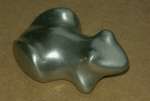
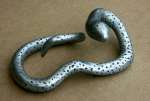
For the bookends (one of which has disappeared) I used the same polystyrene blocks as a starter but added some extra curves.The abstract shape of the fawn was also inspired by one of these blocks. The curve of its back was around a large hole and the gap between its body and front legs was round a small hole. The curl-ups were of course inspired by the one of the drawings of M C Escher, whose work I admire. The snake was a bit of fun, also made from a polystyrene model.
The small horned head of an animal looks as if it was made from a wax model, which is odd because I thought the lost wax castings were all bronze. I must have given it to one of the children because I only found it 35 years later.
Pictures
Click on images for larger version and use arrows to move between pictures.
All material Copyright © 1980 - 2007 John Harrison.