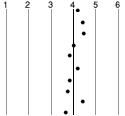
 Make sure your pupil understand that even good ringing will look a bit ragged on the display, for example, the result
shown here would sound quite good to listen to.
Make sure your pupil understand that even good ringing will look a bit ragged on the display, for example, the result
shown here would sound quite good to listen to.
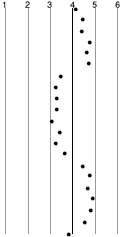
Ringing with a simulator can magnify some problems that pupils often have when trying to fit in with the even rhythm of ringing. If your simulator has the facility to review the striking by looking at a display after ringing, this is useful to help explain things. The format may vary depending on your simulator software, but usually it shows a column for each position, with the actual positions where the bells struck. In the diagrams here, the vertical lines show the correct places, the dots show the pupil's bell, and for simplicity the other bells (which would be on the lines) aren't shown. In all examples, the pupil is ringing in 4th place, shown by a black line.
Make sure your pupil understand that even good ringing will look a bit ragged on the display, for example, the result
shown here would sound quite good to listen to.
Over and above this low level variability, the display is useful for showing some common problems, for example:
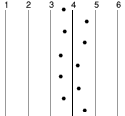 Failure
to get the right balance between handstroke and backstroke timing. This is quite common, and often gets ignored in general
ringing if the two strokes added together achieve the right overall speed. The more common error is to be wide at backstroke
and close at hand, because the pupil isn't adequately imposing the open lead rhythm, but some pupils over do it by not letting
the bell rise properly at backstroke and compensating by letting it go too far over the balance at handstroke.
Failure
to get the right balance between handstroke and backstroke timing. This is quite common, and often gets ignored in general
ringing if the two strokes added together achieve the right overall speed. The more common error is to be wide at backstroke
and close at hand, because the pupil isn't adequately imposing the open lead rhythm, but some pupils over do it by not letting
the bell rise properly at backstroke and compensating by letting it go too far over the balance at handstroke.
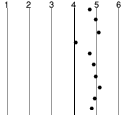
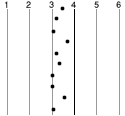 Struggling
to ring at the same speed as the simulator may be caused by the rope
being too long or too short, or just by the pupil expecting
to ring at a different speed. The symptoms are a persistent bias
either to striking late or striking early, as shown here.
Some times after an extended period of doing one, the pupil will
suddenly ‘change gear’ and switch to doing the other. Often
this is associated with taking in or letting out an undue amount of
rope, but not always.
Struggling
to ring at the same speed as the simulator may be caused by the rope
being too long or too short, or just by the pupil expecting
to ring at a different speed. The symptoms are a persistent bias
either to striking late or striking early, as shown here.
Some times after an extended period of doing one, the pupil will
suddenly ‘change gear’ and switch to doing the other. Often
this is associated with taking in or letting out an undue amount of
rope, but not always.
 Another
common problem is ‘
Another
common problem is ‘